
Unique Paths (LeetCode 62)
There is a robot on an
m x ngrid. The robot is initially located at the top-left corner (i.e.,grid[0][0]). The robot tries to move to the bottom-right corner (i.e.,grid[m - 1][n - 1]). The robot can only move either down or right at any point in time.Given the two integers
mandn, return the number of possible unique paths that the robot can take to reach the bottom-right corner.The test cases are generated so that the answer will be less than or equal to
2 * 109.
Example 1:
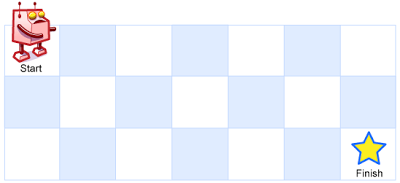
Input: m = 3, n = 7
Output: 28
Example 2:
Input: m = 3, n = 2
Output: 3
Explanation: From the top-left corner, there are a total of 3 ways to reach the bottom-right corner:
- Right -> Down -> Down
- Down -> Down -> Right
- Down -> Right -> Down
class Solution {
    public int uniquePaths(int m, int n) {
        int[][] dp = new int[m][n];
        for (int i = 0; i < m; i++) {
            dp[i][0] = 1;
        }
        for (int j = 0; j < n; j++) {
            dp[0][j] = 1;
        }
        for (int i = 1; i < m; i++) {
            for (int j = 1; j < n; j++) {
                dp[i][j] = dp[i - 1][j] + dp[i][j - 1];
            }
        }
        return dp[m - 1][n - 1];
    }
}
class Solution:
def uniquePaths(self, m: int, n: int) -> int:
dp = [[1] * n for _ in range(m)]
for i in range(1, m):
for j in range(1, n):
dp[i][j] = dp[i - 1][j] + dp[i][j - 1]
return dp[m - 1][n - 1]| Type | Value |
|---|---|
| Time | O(m*n) |
| Space | O(m*n) |
- Approach: Use a 2D array
dpwheredp[i][j]represents the number of unique paths to reach cell(i, j). The number of paths to(i, j)is the sum of paths from(i-1, j)(above) and(i, j-1)(left). - Dry run (m=3, n=2):
- initialize paths in row 0 and col 0 to 1
- dp = [[1, 1],
[1, ?],
[1, ?]] - i=1, j=1: dp[1][1] = dp[0][1] + dp[1][0] = 1 + 1 = 2
- i=2, j=1: dp[2][1] = dp[1][1] + dp[2][0] = 2 + 1 = 3
- result: dp[2][1] = 3
Edit Distance (LeetCode 72)
Given two strings
word1andword2, return the minimum number of operations required to convertword1toword2.You have the following three operations permitted on a word:
- Insert a character
- Delete a character
- Replace a character
Example 1:
Input: word1 = "horse", word2 = "ros"
Output: 3
Explanation:
horse -> rorse (replace 'h' with 'r')
rorse -> rose (remove 'r')
rose -> ros (remove 'e')
Example 2:
Input: word1 = "intention", word2 = "execution"
Output: 5
Explanation:
intention -> inention (remove 't')
inention -> enention (replace 'i' with 'e')
enention -> exention (replace 'n' with 'x')
exention -> exection (replace 'n' with 'c')
exection -> execution (insert 'u')
Constraints:
0 <= word1.length, word2.length <= 500word1andword2consist of lowercase English letters.
class Solution {
    public int minDistance(String word1, String word2) {
        int m=word1.length();
        int n=word2.length();
        int dp[][]=new int[m+1][n+1];
        for(int i=1;i<=m;i++) dp[i][0]=i;
        for(int i=1;i<=n;i++) dp[0][i]=i;
        for(int i=1;i<=m;i++){
            for(int j=1;j<=n;j++){
                if(word1.charAt(i-1)==word2.charAt(j-1)){
                    dp[i][j]=dp[i-1][j-1];
                }else{
                    int tl=dp[i-1][j-1];
                    int t=dp[i-1][j];
                    int l=dp[i][j-1];
                    dp[i][j]=Math.min(l,Math.min(tl,t))+1;
                }
            }
        }
            return dp[m][n];
    }
}
class Solution:
def minDistance(self, word1: str, word2: str) -> int:
m, n = len(word1), len(word2)
dp = [[0] * (n + 1) for _ in range(m + 1)]
for i in range(1, m + 1):
dp[i][0] = i
for j in range(1, n + 1):
dp[0][j] = j
for i in range(1, m + 1):
for j in range(1, n + 1):
if word1[i - 1] == word2[j - 1]:
dp[i][j] = dp[i - 1][j - 1]
else:
dp[i][j] = min(dp[i - 1][j - 1], dp[i - 1][j], dp[i][j - 1]) + 1
return dp[m][n]| Type | Value |
|---|---|
| Time | O(m*n) |
| Space | O(m*n) |
- Approach: Use a 2D DP array where
dp[i][j]represents the minimum edit distance between the firsticharacters ofword1and the firstjcharacters ofword2. If the characters match,dp[i][j] = dp[i-1][j-1]. Otherwise, consider insertion(dp[i][j-1]), deletion(dp[i-1][j]), and substitution(dp[i-1][j-1])and add 1 to the minimum of these. - Dry run (word1="sea", word2="eat"):
- Initialize
dp: sizes 4x4.dp[i][0] = i,dp[0][j] = j. - i=1 ('s'), j=1 ('e'): no match ->
min(dp[0][0], dp[1][0], dp[0][1]) + 1=min(0, 1, 1) + 1= 1 - i=1 ('s'), j=2 ('a'): no match ->
min(dp[0][1], dp[1][1], dp[0][2]) + 1=min(1, 1, 2) + 1= 2 - i=2 ('e'), j=1 ('e'): match ->
dp[1][0]= 1. - i=3 ('a'), j=2 ('a'): match -> inherits
dp[2][1], which eventually leads to optimal min distance 2.
- Initialize